This new, free, practical guide aims to establish a consistent approach to safety assessment and support the responsible development of innovative marine technologies.
HPi Verification Services (HPiVS) is launching a new Risk Assessment Reference Guide for Small Craft at METSTRADE 2026. It provides the marine industry with the correct method to carry out a risk assessment to demonstrate a product is safe.
The guide is available free of charge through the HPiVS website, making it accessible to manufacturers, naval architects, engineers, regulators, and other stakeholders throughout the global marine industry.
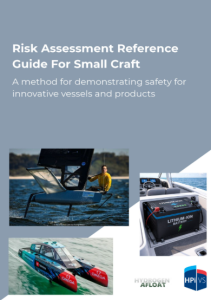
As marine technology continues to evolve, manufacturers and designers are increasingly developing products and systems that are not covered by existing regulatory standards. From alternative propulsion technologies and advanced battery systems to hydrofoils and new materials, innovation is moving quickly, creating new challenges for those responsible for demonstrating product safety.
The industry needs a consistent, structured approach to assessing these emerging risks. The new guide has been developed to help meet that need, providing practical guidance on how established risk assessment techniques can be applied to small craft.
Developed by HPiVS CEO Alasdair Reay, alongside Nick Swift of Hydrogen Afloat, the guide draws on established safety assessment approaches used in sectors such as automotive, aerospace, nuclear, and rail. It explains how Potential Failure Mode and Effects Analysis (FMEA) can be applied at different levels, from an entire craft to individual systems, subsystems and components. It also explores the use of the Bow Tie Method for assessing specific hazards.
Alasdair Reay, CEO of HPiVS, commented:
“Unlike other sectors where risk assessment is mandatory, the small craft sector has never been asked to carry out formal risk assessments, so it has had little reason to build that capability. That is changing. ISO 23625 now requires manufacturers to document their “safety philosophy” for lithium-ion battery installations. We are often asked how this should be done. Boatbuilders, system integrators and equipment suppliers need practical, accessible methods, and I hope this guide gives them a way in.
“Risk assessment is not new, and this guide doesn’t pretend otherwise. HAZID, FMEA and bow tie analyses have been proven over decades in other sectors. What we have done is bring those established methods together in a form that makes sense for recreational craft.”
METSTRADE: bringing the industry together
HPiVS will use METSTRADE 2026 as an opportunity to introduce the guide to the industry and, more importantly, start conversations about how it can be applied to real-world projects.
The team is particularly keen to meet manufacturers, designers, engineers and innovators who are developing new technologies or working on projects where existing standards and conventional assessment methods may not fully address the risks involved.
Whether you are developing a new propulsion system, introducing alternative battery technology, designing a hydrofoil craft, modifying an existing vessel or bringing another innovative product to market, the HPiVS team would welcome the opportunity to discuss your project and explore how structured risk assessment could help.
The intention is not simply to present another guidance document, but to encourage a wider industry conversation about how we collectively approach safety, share knowledge and support the responsible introduction of new technologies.
Alasdair Reay added:
“Our hope is that this document will be a seed for the industry to develop and publish its own guidance, shaped by the people who build, fit and maintain these boats every day. To encourage that, we are making the guide available free of charge on our website.
“Better risk assessment will make boats safer for the people who use them, and I would encourage everyone in the sector to read the guide, use it, challenge it, and help improve it.”
Access the free guide and meet HPiVS at METSTRADE 2026
The Risk Assessment Reference Guide for Small Craft is available free of charge via the HPiVS website:
https://www.hpivs.com/risk-assessment-guide
Visitors to METSTRADE 2026 are also invited to meet the HPiVS team at stand 03.422 to discuss the guide, explore its practical application and talk about the safety challenges associated with their own marine projects.