
Frequently asked questions about boat CE marking and compliance:
Requirements and regulations for installing lithium ion batteries on small craft
In 2025, the first edition of ISO 23625 Small Craft: Lithium Ion Batteries was published. This standard does not set any detailed requirements for the storage and ventilation of lithium ion batteries. Instead, it requires only that:
“In case of a failure mode that results in a cell venting, the battery installation shall allow for cell venting such that the safety of persons onboard is not endangered.”
and
“The safety philosophy for the energy storage space (ESS) shall be documented.”
The standard does not prescribe, for example, if batteries may be installed in the accommodation or if they must be fixed in a metal box, vented to the exterior. These details are left to a documented safety philosophy, which we may call a risk assessment.
HPiVS is currently co-authoring ICOMIA’s Guide on Risk Assessments for the small craft industry. This will be released in 2nd quarter of 2026. Until then, please approach HPiVS to discuss methods of risk assessment. There are many!
This page points out HPiVS’ minimum expectations and provides information for others to use in an informed risk assessment.
Swapping conventional for lithium batteries on boats
The EU Recreational Craft Directive requires that if a CE marked boat undergoes a Major Craft Conversion, it must be certified by a Notified Body using Post Construction Assessment (PCA). The official forum of Notified Bodies (RSG) has decreed that changing conventional batteries for lithium constitutes a major craft conversion and so PCA will be required.
WARNING: the charging requirements of lithium can be very different to conventional batteries. Do not think a simple exchange of conventional to lithium is all that is necessary!
Cell Quality
Some say “modern, good quality cells are safe”. But how does one recognise good or bad quality cells within a battery when it is on a shelf in the shop? ISO 23625 provides the answer.
Cells shall conform to:
- IEC 62619 Safety requirements for secondary lithium cells and batteries, for use in industrial applications, and
- IEC 62620 Secondary cells and batteries containing alkaline or other non-acid electrolytes
HPiVS will not certify boats with lithium ion batteries whose documentation fails to confirm conformity with these standards.
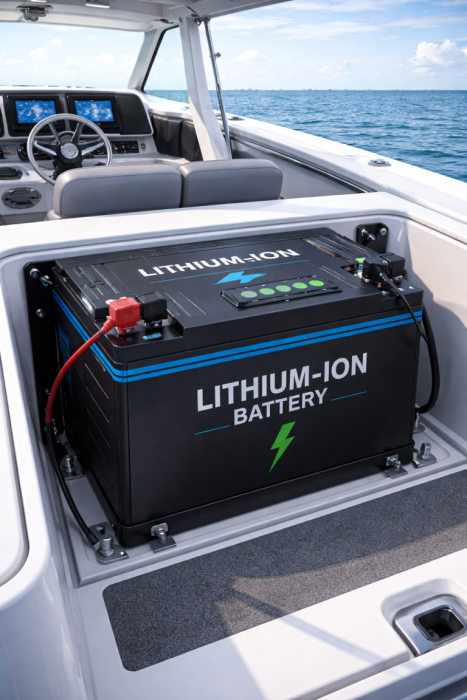
Ventilation
One feature that is clear is that ventilation shall be provided in some form. This is clear because ISO 23625 says we must keep people safe should a cell vent. But should the batteries be provided with dedicated/independent ventilation to the exterior or is it enough to vent into a vented space?
The current edition of the standard does not demand that batteries have their own independent vent lines to the exterior unless the battery manufacturer or the risk assessment require it.
Cell Technology
Again, some say that “LFP batteries are safe and it is only other technologies we need to worry about.”
If it was that simple, ISO 23625 would distinguish between different cell technologies. It does not, but a risk assessment can.
Accident statistics from a number of industries bear testimony that some battery technologies are less likely to vent than others. For some technologies, it is certain that runaway follows venting, whereas others may vent a cell without concern of runaway.
Note that the requirement to keep people safe refers to “a cell” – a single cell – venting, not an entire battery in runaway.
So, if a risk assessment shows that for a specific battery and installation, the calculated risk of runaway is tolerable, then the boat manufacturer needs only to be concerned with venting of a single cell. See ‘ventilation’ alongside.
Battery manufacturer installation specifications shall be met
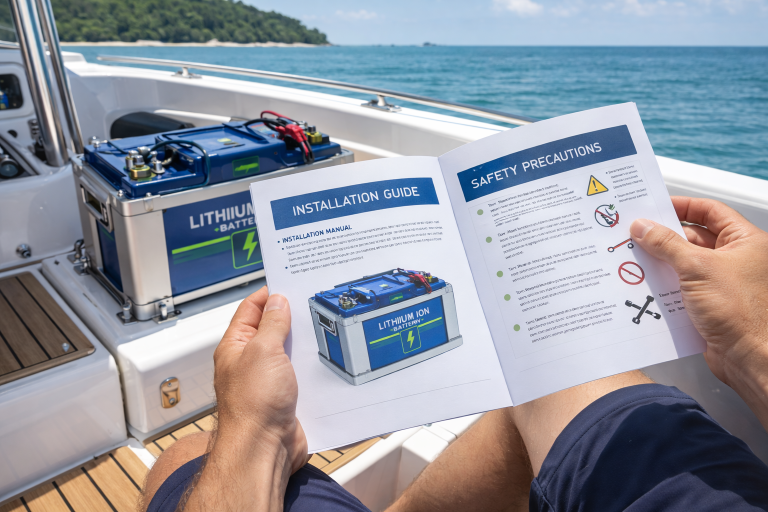
The standard demands that the batteries shall be fitted according to the manufacturer’s instructions. These might cover the following:
- Location (e.g. not in a habitable space)
- Ventilation (e.g. direct to exterior)
- Distance from other batteries of sources of heat and vibration
- Temperature or cooling
- Means of fixing in position
There is not much consistency between manufacturers with regards to installation instructions. If it is not clear, ask them.
HPiVS will not certify boats with lithium ion batteries where the manufacturer cannot show they have followed the battery manufacturer’s installation requirements.
Reference Points
The following tables are offered merely as a reference point for risk assessments.
Standards
Standard | Sector | Requirement |
|---|---|---|
AS/NZS 3001.2:2022 | Caravans, motorhomes, campervans, camper trailers, and similar mobile units | Lithium batteries in living areas must be in a dedicated compartment vented to the exterior or in a compliant, sealed enclosure to manage potential fumes. |
UK MGN 550 | Craft being used commercially | Batteries shall be located within either a steel plated battery box or room with A60 fire integrity, or equivalent. |
ISO 23625:2025 | Recreational craft with hull length < 24m | Installation must keep people safe when a single cell of a lithium battery is venting. Risk assessment required to consider all risks, including thermal runaway. |
ABYC E-13 | Boats up to 24m in length | No specific requirements for installation other than away from sources of heat, physical damage and as per manufacturer’s instructions. |
Statistics for Risk Assessment
- UK Product Safety Database
- UK Scientific Advisory Group for Emergencies
- Accident statistics – UK RoSPA website
- Statistics – NHS England website
- Fire statistics data tables – UK Home Office
- Statistics – UK Department for Transport
- Mortality statistics – UK Office for National Statistics
- National Electronic Injury Surveillance System (NEISS) – United States Consumer Product Safety Commission website
- Safety-related complaints about consumer products – United States Consumer Product Safety Commission website
- Information on chemicals – European Chemicals Agency website
In the past, builders did not declare their boats to the EU ElectroMagenetic Compatibility Directive (EMC) on the basis that they were selling a boat not an electrical product. Boat builders would also say that they buy and fit only UKCA/CE marked electrical components, so EMC compliance is implicit. Interestingly, however, the manufacturers of PWC have always declared to EMC. HPiVS own research into EMC, which included a visit to an anechoic chamber, shows that components can interact and that every cable is a potential EMC antenna.
Thus a circuit of EMC compliant components can fail an EMC test when combined. Indeed, HPiVS saw such a battery charger fail its EMC test in the chamber. So if the assembly of a boat’s electrical system could potentially lead to an EMC problem, should builders be checking and declaring boats compliant with the EMC Regulations/Directive? At the RSG meeting in Stockholm on 4th February 2013, attended by HPiVS’ CEO Alasdair Reay, the EU Commission representative said “yes”. It would appear that the EU Commission is concerned that a range of products incorporating electrical components are not paying due attention to the risks of EMC. To maintain easy export of UK products to EU, the UK Government is expected to take thee same view as the Commission.

That is all very well but how does a boat builder test a 78ft boat? There are only a couple of chambers in the world that could accommodate such a boat and if each conductor’s length and route could influence the EMC signal, should every possible option be tested? It is possible to do EMC testing in the field and HPiVS has also taken part in some of these. This requires an environment free of EMC signals which will certainly not be the case at any boat yard. As the EMC immunity test throws out strong pulses, it also must be done where the neighbours don’t have any sensitive equipment.
This is all unworkable but on 28th January 2013, ICOMIA came to the rescue of the industry by publishing their RECOMMENDATIONS ON ASSESSMENT FOR EMC COMPLIANCE OF SMALL CRAFT UNDER UK Regulation 2004/108/EC. ICOMIA says:
This document outlines step-by-step assessment recommendations on compliance for the Electromagnetic Compatibility (EMC) Directive for boats and is expected to guide boatbuilders through this process.
This is a “guideline” and not a “standard” and it is certainly not a designated/harmonised standard Standards which have been especially written to support the regulations/directive and which have been adopted as national standards by UK and all EU member states.but it is all we have in the boating industry on the subject of EMC. As it is not designated/harmonised, no Government can insist upon the use of this document and conversely, neither can they guarantee that it meets the requirements of the EMC Regulations/Directive. But if the industry uses it, it is a de facto “industry standard” and in the absence of any alternative, how could a court find against a boat builder for following it. So, ICOMIA’s document provides the only useful basis on which to declare compliance with EMC for a boat.
This is a “guideline” and not a “standard” and it is certainly not a designated/harmonised standard Standards which have been especially written to support the regulations/directive and which have been adopted as national standards by UK and all EU member states.but it is all we have in the boating industry on the subject of EMC. As it is not designated/harmonised, no Government can insist upon the use of this document and conversely, neither can they guarantee that it meets the requirements of the EMC Regulations/Directive. But if the industry uses it, it is a de facto “industry standard” and in the absence of any alternative, how could a court find against a boat builder for following it. So, ICOMIA’s document provides the only useful basis on which to declare compliance with EMC for a boat.
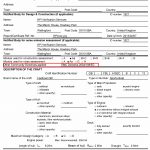
Click to see a sample RCD-EMC Declaration
The guideline is not onerous. It lays out flow charts for selecting compatible components, checking assembly follows good practice and how to document it all. HPiVS welcomes the document and recommends its application to all its clients, though, as it is not a Approved Body for EMC, HPiVS has no right to withhold a RCR certificate on the grounds of EMC. (It should be noted that certification by Approved Body is never mandatory for EMC).
The existing RCR template for the Declaration of Conformity has space to refer to EMC. See HPiVS’ Sample RCR EMC Declaration.
For further details, contact us.
The Regulations state:
The following shall be excluded from the scope of this Regulation: …….. craft built for own use, provided that they are not subsequently placed on the Community market during a period of five years;
The first point to note is that the boat is not exempt until 5 years have passed. During that 5 year period the boat is in a sort of limbo period with regards to its status. During this time, the boat may not change ownership, even if given away without charge. For some reason, divorce and home-build boats appear to go hand-in-hand and HPiVS deals with several cases every year where a home-build is having to be UKCA marked before the 5 years have passed because the boat is to be sold as part of the divorce settlement!
The big question that this exemption raises, however, is when does the 5-year clock start ticking? The answer is when the boat is complete. But when is a boat complete? The best interpretation that HPiVS has heard quoted by a lawyer is:
A product is complete when it can be used to its full design capabilities.
But be careful! The UK Government recently decreed that a ‘sail-away’ boat is complete when it is navigable, even if its interior is not fully fitted-out. So, it is probably safest to interpret ‘complete’ as being when the boat can be navigated. This raises the next, very significant point: whenever an already CE/UKCA marked vessel is modified in such a way that compliance with the regulations may be altered, a formal Post Construction Assessment certificate is required. So if a sailaway is complete and CE/UKCA marked, when you fit it out, even as an owner, you are potentially carrying out a ‘major craft conversion’ and PCA is mandatory. There is no ‘home-builder’ exemption for a major craft conversion.
If you are a home builder, identifying the point of completion and formally recording it is very important. Insurance certificates, registration documents, berthing receipts etc. are all useful evidence.
The final question to consider is whether the home-builder can contract out some work or does he have to do it all himself? The EU Commission’s own guidance document on RCD states the following:
This [exemption of a home-builder] does not preclude the sub-contracting, by the builder, of specialists in certain aspects of the fitting out of the boat e.g. electrical or electronic engineers.
So how much can work be contracted before the builder is no longer the builder in the eyes of the law? There is no clear answer to this question but for guidance, HPiVS would make the following point. The RCD / RCR has distinct Essential Requirements (ER). Any work that does not directly impinge upon these ERs does not constitute work in terms of RCD / RCR.
RCR Essential Requirements
1 DESIGN CATEGORY
2 GENERAL REQUIREMENTS
2.1 Craft Identification Number;
2.2 Builder’s Plate;
2.3 Protection from falling overboard & means of re-boarding;
2.4 Visibility from the main steering position;
2.5 Owner’s manual:
3 INTEGRITY AND STRUCTURAL REQUIREMENTS
3.1 Structure;
3.2 Stability and freeboard;
3.3 Buoyancy and floatation;
3.4 Openings in hull, deck and superstructure;
3.5 Flooding;
3.6 Manufacturer’s maximum recommended load;
3.7 Liferaft stowage;
3.8 Escape;
3.9 Anchoring, mooring and towing:
4 HANDLING CHARACTERISTICS
5 SYSTEMS
5.1 Engines and engine spaces;
5.2 Fuel system;
5.3 Electrical systems;
5.4 Steering systems;
5.5 Gas systems;
5.6 Fire protection;
5.7 Navigation lights;
5.8 Discharge prevention
It should be noted that joinery, decoration and furnishings do not appear in the ERs. So fitting out a boat with cabins, berths, seats, lockers etc does not constitute “building” and would not qualify a person as a “home-builder” in terms of the RCR. On the contrary, a home-builder would be expected to have completed a number of the regulated systems, listed above, in order to qualify.
To provide some clarity, one can show that many nations, including UK, have regulations that require only qualified/registered individuals to fit gas & electrical systems. So it would be considered normal to contract out work on these systems. But the other systems are not associated with their own distinct fitter-qualifications and a home builder would be expected to have completed the majority of these himself.
To talk about the specifics of a case, contact us.
We are often asked what happens to the validity of certificates when a manufacturer closes, particularly when bankrupt and no transfer of ownership results. This question was posed to the EU Commission for a legal ruling (and we believe UK will follow the same path) and they have returned with the following:
The EC type examination certificate for the boat placed on the market remains valid even after the manufacturer bankrupted.The EC type-examination certificate refers to a product, not to the manufacturer.
In case there is a new manufacturer who wants to produce the same type of boat under the same brand, he must apply for the new EC type examination certificate because this certificate always applies to a particular manufacturer. This manufacturer also has to put his name on the EU Declaration of Conformity.
However, the Body assessing the product should take into consideration the fact that the new manufacturer may use the same manufacturing methods & technologies including the material and workforce as the previous original manufacturer. For this case, the scope of assessment should not create unnecessary burden for the manufacturer.
In case of change of the manufacturer’s ownership, the EC type examination certificate remains valid until the manufacturer continues his business under the same legal entity.
Note that while the above refers to Type Approval certificates, it would also apply to module Aa certificates. It does not apply to other types of certificate (module D, E, F, G or H) as these certificates relate to specific units of production or production processes. There is, therefore, no carry-over of these certificates.
For further information, contact HPiVS.
Yes!
All the CE (for EU including UK) and UKCA (UK-only) marking regulations, including RCD / RCR, require that a product be compliant when it is first put on the market or when it is first put into service in UK or EU. So, unless your boat is exempt for another, genuine, reason, (see more on exemptions here) it must be UKCA marked when you use it or sell it.
The only possible exception is if you build a boat for your own use. In such a case, the boat becomes exempt after it has been in service for five years. See a separate note for home builds.
This is an increasingly common question as insurance companies and registration authorities (outside Europe) sometimes demand that a boat’s unique (hull/craft/watercraft) identification number be shown on the certificate. The answer is that it depends upon the conformity assessment module being applied. Some boats are only ‘type approved’ by an Approved/Notified Body and thus the certificate relates to a model – ie the design of the boat, not to a specific unit of production. An Approved or Notified Body will not put the unique ID of a boat on such a certificate because they are not involved in checking on-going production and so cannot state whether or not any specific unit complies. This is the manufacturer’s responsibility, using the Declaration of Conformity which they must issue for each unit.
There are optional conformity assessment modules where the manufacturer can ask the Approved Body to witness the production of a single unit or a batch of production units. In this case, the Approved Body should print the ID numbers of the units concerned on the certificate. Note that the Approved Body will clearly charge money to make special visits to the manufacturer and assess specific units of production. Thus the boat buyer should expect to pay more money if this service is required. A list of the ‘conformity assessment modules’ is described below.
REF. | TITLE OF MODULE | ID ON CERTIFICATE |
|---|---|---|
A | Internal Production Control | N/A – no Approved Body involvement |
Aa or A1 | Internal Production Control Plus Supervised Product Testing | Only if the sample used for testing is unique or represents a defined batch |
B+ | EU Type-Examination | Never |
+C | Conformity to Type | N/A – no Approved Body involvement |
+D | Quality Assurance of the Production Process | Never |
+E | Product Quality Assurance | Never |
F | Product Verification | Depends upon scope of work agreed between manufacturer & Approved Body |
G | Unit Verification | Always |
H | Full Quality Assurance | Never |
One of the most common questions we receive is whether a commercial boat is exempt from the RCD or whether it needs a CE mark. There is good reason for the confusion. The RCD states:
The following shall be excluded from the scope of these Regulations: …… craft specifically intended to be crewed and to carry passengers for commercial purposes.
Many people make the mistake of assuming all craft being used for “commercial purposes” are excluded. But the EU Commission’s guidance document on the RCD states:
chartered, i.e. hired, recreational craft are covered by the Directive, as are recreational craft used for recreational boating training. In both cases, the activity is not a commercial passenger transport activity but one for sports or leisure purposes, even if the craft is hired with crew.
This means that a boat is not excluded simply because money is exchanging hands for the use of the boat. Further, it is not necessarily exempt if there is a paid crew on board the hired craft.
The key to this conundrum is to focus on the use of the boat. If it is clearly being used for recreation, ie simply for the pleasure of passing some time afloat, then it is in scope, regardless of money or crew. If the hired boat is being used as a mode of transport, or for racing, then it is excluded. Note also that education/training is not excluded if it relates to using the craft recreationally.
It is not true that a boat is exempt from RCD because it has approval as a commercial vessel.
It should also be remembered that an excluded boat may be sold into the recreational market later in its life. The boat would need to be CE marked (or UKCA marked for UK-only) at this stage. As a result, it may be worthwhile dealing with the commercial approval and CE marking at the same time as the two regimes overlap.