

CE certification for pressure equipment and assemblies under the EU Pressure Equipment Directive 2014/68/EU
HPiVS is an EU Notified Body providing Pressure Equipment Directive (PED) certification and CE marking for pressure equipment and assemblies under Directive 2014/68/EU.
The PED applies to a wide range of pressure equipment, including:
Steam boilers
Pressure vessels
Piping
Safety valves
Is PED certification mandatory?
Pressure equipment must display a CE mark to be sold or used in Europe (including the UK). This mark confirms compliance with the EU Pressure Equipment Directive.
For equipment placed on the UK market only, manufacturers can apply a UKCA mark. This confirms compliance with the UK Pressure Equipment (Safety) Regulations.
Who needs PED certification?
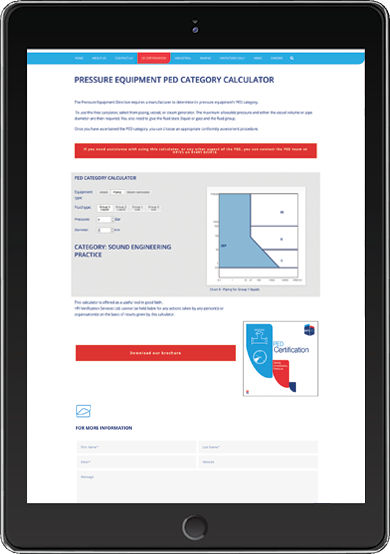
You can use our Pressure Vessel Category Calculator to identify your risk category for FREE.
PED 2014/68/EU certification
We give you peace of mind that your products or systems fully comply with European standards.
We also operate as an ISO 17065:2012 accredited UK Approved Body. This accreditation authorises us to issue UKCA certificates for new pressure equipment covered by the UK Pressure Equipment (Safety) Regulations (PE(S)R).
As a result, we can issue both CE and UKCA certification if required, saving you time and reducing costs.
Is PED the same as CE?
No, although they are closely related, they are not the same. PED stands for the Pressure Equipment Directive, while CE is a conformity mark.
The PED is a European directive that defines the essential safety requirements for pressure equipment. The CE mark shows that a product complies with applicable health, safety, and environmental requirements, including those set out in the PED. By carrying a CE mark, a product can be sold freely across Europe, including the UK.
.
What is a PED certificate?
A Pressure Equipment Directive (PED) certificate confirms that pressure equipment and assemblies meet the essential safety requirements for use in the European Union and the UK.
What is the EU Pressure Equipment Directive?
Official Reference
2014/68/EU
Date of Enforcement
18th Jul 2016
97/23/EC Superseded from 18th Jul 2016.
What is the scope of the EU Pressure Equipment Directive?
The directive applies to the design and manufacture of individual items and assemblies of pressure equipment with a maximum allowable pressure greater than 0.5 bar (gauge). Any product that contains pressure above 0.5 bar falls within its scope.
Safety accessories also fall within scope, even if they do not contain this level of pressure. For example, a pressure or temperature switch comes within scope when it functions as a safety control for pressure equipment.
What are the exclusions to the EU Pressure Equipment Directive?
The directive excludes certain types of equipment. These are primarily those already regulated under other directives or regulations. For example, regulations covering the transport of pressurised containers for fluids take precedence.
EXCLUDED PRESSURE EQUIPMENT AND ASSEMBLIES
Pipelines comprising piping or a system of piping designed for the conveyance of any fluid or substance to or from an installation (onshore or offshore). Starting from and including the last isolation device located within the confines of the installation, including all the annexed equipment designed specifically for pipelines. This exclusion does not apply to standard pressure equipment such as may be found in pressure reduction stations or compression stations;
- Networks for the supply, distribution and discharge of water and associated equipment and headraces. Such as penstocks, pressure tunnels, pressure shafts for hydroelectric installations and their related specific accessories;
- Equipment covered by Directive 87/404/EEC(21) on simple pressure vessels;
- Equipment covered by Council Directive 75/324/EEC of 20 May 1975 on the approximation of the laws of the member States relating to aerosol dispensers(22);
- Equipment intended for the functioning of vehicles defined by the following Directives and their Annexes:
- Council Directive 70/156/EEC of 6 February 1970 on the approximation of the laws of the member States relating to the type-approval of motor vehicles and their trailers;
- Council Directive 74/150/EEC of 4 March 1974 on the approximation of the laws of the member States relating to the type-approval of wheeled agricultural or forestry tractors;
- Council Directive 92/61/EEC of 30 June 1992 relating to the type-approval of two or three-wheel motor vehicles;
- Equipment classified as no higher than category I under Article 9 of this Directive and covered by one of the following Directives:
- Council Directive 89/392/EEC of 14 June 1989 on the approximation of the laws of the member States relating to machinery;
- European Parliament and Council Directive 95/16/EC of 29 June 1995 on the approximation of the laws of the member States relating to lifts;
- Council Directive 73/23/EEC of 19 February 1973 on the harmonisation of the laws of the member States relating to electrical equipment designed for use within certain voltage limits;
- Council Directive 93/42/EEC of 14 June 1993 concerning medical devices;
- Council Directive 90/396/EEC of 29 June 1990 on the approximation of the laws of the member States relating to appliances burning gaseous fuels;
- Directive 94/9/EC of the European Parliament and the Council of 23 March 1994 on the approximation of the laws of the member States concerning equipment and protective systems intended for use in potentially explosive atmospheres;
- Equipment covered by Article 296(1)(b) of the Treaty;
- Items specifically designed for nuclear use, failure of which may cause an emission of radioactivity;
- Well-control equipment used in the petroleum, gas or geothermal exploration and extraction industry and in underground storage which is intended to contain and/or control well pressure, that is to say the well head (Christmas tree), the blow out preventers (BOP), the piping manifolds and all their equipment upstream;
- Equipment comprising casings or machinery where the dimensioning, choice of material and manufacturing rules are based primarily on requirements for sufficient strength, rigidity and stability to meet the static and dynamic operational effects or other operational characteristics and for which pressure is not a significant design factor, such equipment may include:
- engines including turbines and internal combustion engines,
- steam engines, gas/steam turbines, turbo-generators, compressors, pumps and actuating devices;
- Blast furnaces including the furnace cooling system, hot-blast recuperators, dust extractors and blast-furnace exhaust-gas scrubbers and direct reducing cupolas, including the furnace cooling,gas converters and pans for melting, re-melting, de-gassing and casting of steel and non-ferrous metals;
- Enclosures for high-voltage electrical equipment such as switchgear, control gear,transformers, and rotating machines;
- Pressurised pipes for the containment of transmission systems, including for example electrical power and telephone cables;
- Ships, rockets, aircraft and mobile off-shore units, as well as equipment specifically intended for installation on board or the propulsion thereof;
- Pressure equipment consisting of a flexible casing, including for example tyres, air cushions,balls used for play, inflatable craft, and other similar pressure equipment;
- Exhaust and inlet silencers;
- Bottles or cans for carbonated drinks for final consumption;
- Vessels designed for the transport and distribution of drinks having a PS.V of not more than 500 bar-L and a maximum allowable pressure not exceeding 7 bar;
- Equipment covered by the ADR, the RID, the IMDG and the ICAO Convention;
- Radiators and pipes in warm water heating systems;
- Vessels designed to contain liquids with a gas pressure above the liquid of not more than 0.5 bar.
Products are either in scope and must be CE marked or they are outside the scope and may not be CE marked. There is no choice on this issue.
There is no legal means whereby an excluded product can be CE marked. If your product is excluded from the directive, we will let you know.
What are PED Harmonised Standards?
Harmonised Standards define the detailed technical requirements for design, materials, manufacturing, and testing.
When a product conforms to Harmonised Standards, it is presumed to comply with the directive. However, manufacturers do not have to apply these standards. If Harmonised Standards do not suit a specific product, manufacturers may use alternative standards or technical solutions, provided they demonstrate an equivalent level of safety.
Demonstrating equivalent safety can be challenging. As a result, manufacturers should apply Harmonised Standards wherever possible.
Get in touch with us now to find out more.
Visit the EU Commission’s website for an up-to-date list of harmonised standards for PED.
Rulefinder Online Access to Standards
HPiVS has developed Rulefinder to give industry professionals comprehensive access to legislative standards and texts alongside unique insights into compliance requirements. This includes:
- EN and ISO Standards
- Current and superseded editions
- Table of dates: publication, EU/UK harmonisation, expiry of presumption of conformity
- UK and EU Legislation
- The EU Pressure Equipment Directive (PED)
- UK ‘PE(S)R’.
Guidelines include:
- Table of dates; publication, EU/UK harmonisation, expiry of presumption of conformity.
The standards are sold in section packages, so you can access just the information you need. Click here to find out more about Rulefinder.

Do I need an Approved Body to certify my pressure equipment?
The Regulations have a wide range of Conformity Assessment Modules which define what documentation needs to be compiled and to what extent an Approved Body should be involved. The choice of modules is limited depending upon the risk of the product. For PED, the risk of the product is based upon three factors:
- The state of the contained fluid;
- The stored energy (pressure x volume or DN);
- The hazards associated with the fluid.