
What the indefinite delay of the UKCA mark means for boat building and selling


HPi-CEproof is the only Approved Body empowered to issue ‘UKCA mark’ certificates under the new UK Recreational Craft Regulations that came into force on 1 January this year
The Oxfordshire-based company’s ability to issue the new RCR type approval certificates enables compliance with the post-Brexit UK Recreational Craft Regulations. For that reason it is a vital new service for the global boatbuilding community in order to maintain future UK market access.

Celebrating the significance of its appointment, the Oxfordshire-based company auctioned the rights for a boatbuilder to be assessed for RCR certificate number one. Proceeds were split equally between the Blue Marine Foundation (BLUE) and British Divers Marine Life Rescue. No fees were charged for the assessment.
The auction winner, Princess Yachts, chose the fourth off-the-line of its striking X95 class to receive the UK’s first ever RCR certificate. The X95 is a highly innovative recipient, with trend-breaking design, very spacious accommodation and long-range cruising efficiency.
Adam Greene, Senior Naval Architect at Princess Yachts explains: “Our UKCA certificates will use the existing CE marking and technical files as the starting point from which to issue new UKCA certificates. All Princess models will eventually have both CE and UKCA certification, along with conformity statements for US USCG and ABYC rules. HPi-CEproof and HPi Verification Services (Ireland) provide all three requirements for us.”
Alasdair Reay, HPi-CEproof’s CEO, continues: “We had already safeguarded all of our clients prior to the UK’s exit from the EU by transferring their CE conformity to HPi Verification Services (Ireland), which is a fully approved notified body, operating independently. The UK RCR can use the same compliance assessment documentation, since both regimes apply the same standards and all the compliance documentation was already within the company and reviewed by the same personnel.
“The Brexit vote determined the nation’s desire to set its own rules and so we have these new UK regulations. While it is another hurdle for manufacturers to cross, our work with Princess Yachts on this first ever RCR type approval certificate demonstrates that the threshold is low for those who were already set-up for CE marking their products.
“We’d also like to thank the team at Princess for bidding the highest amount in our auction to obtain the very aptly numbered certificate HPiUK-R0001-T001-I-01-00. It’s been tough in recent months for charities and good to be able to support two environmentally-focused causes close to our hearts.”
Emily Norris, BLUE’s Senior Development Manager responded: “We at Blue Marine Foundation (BLUE) are thrilled to receive this generous donation from HPi-CEproof. Thanks to continued support from the yachting industry through donations such as this and from our Blue Marine Yacht Club (BMYC), we can continue our work protecting the world’s ocean.”

In 2021: No. Theafter: Yes.
The UK will continue to recognise the CE mark during 2021, so as to give the UK industry time to issue all the UKCA certificates required. From 1st January 2022, UK will not recognise CE marks: a UKCA mark will be required.
That said, the reality for private buyers (importers) is not as bleak as it appears. The UK-EU trade agreement has a section on technical barriers to trade which explicitly requires both sides to appoint conformity assessment bodies using accreditation to the same rules/standards and same degree of scrutiny. This is so that both sides may trust the work of the other.
This means that if the boat is certified as compliant with RCD by a European Notified Body, UK Approved Bodies are expected to respect this and not exploit the private importer by making a full re-assessment for UKCA certification. So a used boat would subject to a visit to check to confirm it is the boat that was certified, has no (apparent) modifications and is not exhausted. This would incur a cost but not a full assessment fee.
Note, however, that boats which are not (required to be) certified may be treated differently. In the absence of a certifier’s testimony, an UK Approved body will need to conduct a fuller assessment since the builder’s compliance regime may have been untested.
In the other direction: the EU stated, long ago, that it would not recognise the UKCA mark.

No.
UK has become a third country, in EU parlance. Manufacturers in third countries have always been permitted to place recreational craft products on the European (Economic Area) market without a local representative. A manufacturer may, however, choose to have a formal Manufacturer’s Authorised Representative in EEA.
If a manufacturer chooses to have an Authorised Rep, they must:
An authorised rep is responsible for making documentation available but it not actually liable for the product itself. This always remains with the manufacturer. (Though wilful or gross negligence on behalf of the rep would attract liabilty).
Everything said above works the other way around. So a European based representative cannot play the same role for a product being sold into UK.

This appointment is the legal license for the company to issue certificates for the new UK product safety regulations that require the new UKCA Marking.
UK Approved Bodies are also entitled to remain an EU Notified Body but only for goods destined for the Northern Irish market. These products should be marked with both “CE” and “UKNI” marks.
HPi keeps the same identification number (1521) as it held, pre-Brexit, when an EU Notified Body.
See the appointment on the UK government website.
For more details or to apply for an assessment, please contact us.
 In response to the Coronavirus (COVID19) emergency, HPiCEproof has been monitoring advice from HM Government and is committed to ensuring that all activities carried out are in compliance with health and safety requirements during this pandemic.
The government advice for working a safely as possible can be found here. We expect our staff to follows this advice at all times. When we make on-site inspections, we expect our clients to do the same.
HPi CEproof staff continue to provide a full range of services. Staff are working from home, rather than the office but we are fully operational.
HPi CEproof will now carry-out on-site inspections where our inspector can make a day-trip by car. Where this is not possible, HPi CEproof has approved procedures to conduct remote inspections, if the project meets certain criteria. Where this is possible, the client may send video and photographic and written evidence for review in place of an on-site inspection. Each remote inspection must be agreed in advance.
Please contact us through the usual channels to request an inspection, remote or otherwise. Or click here to contact us.
Two of the strongest players in the global marine compliance industry, EU Approved Body HPi-CEproof (HPi-CEproof) and Recreational Craft Regulations specialist CEproof Group have merged, creating HPI-CEproof Ltd.
It has been a milestone 12 months for HPi-CEproof, which completed accreditation with INAB in 2018 for HPi-CEproof (Ireland) Ltd to ISO 17065 so that it can continue to certify products to the EU Recreational Craft Regulations (RCR) and the EU Pressure Equipment (Safety) Regulations. This has enabled HPi-CEproof to provide continuity of service irrespective of Britain’s future status in the EU.
CEproof has enjoyed similarly successful times. Its core UK operation and 10 global offices have continued to develop their tailored services offering detailed and bespoke guidance for compliance with marine legislation, with particular focus on the RCR. The company has also seen wide adoption of its DAME Award-winning software ICOMIA Technical File Generator, which simplifies the entire process of managing RCR compliance documentation.

Speaking of the benefits of the merger, Alasdair Reay, CEO of HPi-CEproof, explained: “CEproof has quietly built a substantial array of software tools for the boat industry with new products launching in the immediate future. By merging the businesses we can add these valuable tools to HPi-CEproof’s outstanding services. Working together we will make compliance easier and more watertight than ever.”
“HPi and CEproof have worked as two links of the same compliance chain for many years,” CEproof CEO and Managing Director, Craig Morris adds. “The future is so exciting now that we are able to combine our world-wide customer base with the abilities and tools of both companies.”
HPi CEproof will be headquartered at HPi-CEproof’s existing base within the technology-focused Howbery Business Park in Wallingford, yalla match UK with CEproof’s Wroxham base in Norfolk, UK becoming a regional office. HPi-CEproof (Ireland) will continue to run from Dunshaughlin, just outside of Dublin. All of CEproof’s consultancy activities will be handled by CEproof’s existing operations in Europe, Western Asia, Australasia and the USA which remain independent and unaffected by the merger.
For further details contact us.

The harmonised standard for Fire Protection, ISO 9094, was updated in 2017 and combined 2 parts into 1. It also introduced a new section on fire detectors. The industry has, unfortunately, found the wording of this new section very difficult to interpret and the Notified Bodies have held long discussions at the RSG group to establish a common guideline. In this article, we explain the guidelines which will soon be published so that you can workout exactly how many detectors are required and where they should be located.
Continue reading
Every morning I am presented with the same challenge: what to wear. It’s not that there is anything wrong with any of the clothes in my wardrobe; individually each one is perfectly adequate for my needs. It’s just that I don’t have an eye for combining them.
My wife on the other hand has no such difficulty. She is able, seemingly without effort, to select and assemble various garments to create a stylish, integrated look; they function perfectly as a whole. Which is fortunate, as she tells me that one poorly chosen item (and shoes are apparently the worst culprits) can be fatal, figuratively speaking that is.

A manufacturer of an assembly faces a similar challenge, and it has a name: global conformity assessment. If you are not familiar, let me explain.
I suspect that this is best demonstrated by an example, albeit a hypothetical one. You would probably rather not be taken through the Pressure Equipment (Safety) Regulations line by line. But a word of caution: whether we like it or not, we are talking about statutory compliance, so it’s important that we don’t lose sight of where the obligations arise from. To prevent these details cluttering up the explanation, I have put them in the endnotes, but that doesn’t diminish their importance. If or when you have time, I recommend that you read the relevant parts of the Directive and Guidelines1.
Putting aside the word ‘global’ for one moment, let’s consider what’s meant by the words ‘conformity assessment’. Conformity assessment is the process carried out by a manufacturer to demonstrate that the relevant requirements of the Directive have been fulfilled. All items of pressure equipment and assemblies falling within PER category I to IV must be subject to a conformity assessment. Global conformity assessment2 is the name given to this process when it is applied to an assembly.
An assembly is several pieces of pressure equipment3 (i.e. vessels, piping, safety accessories, and pressure accessories) assembled by a manufacturer4 to constitute an integrated and functional whole5. In our example below, the assembly manufacturer has purchased a pressure vessel, relief valve, and a globe valve. Each of these items has been UKCA marked by their own respective manufacturers before they were placed on the market. The assembly manufacturer has fabricated the interconnecting piping, which in our case falls into category I.
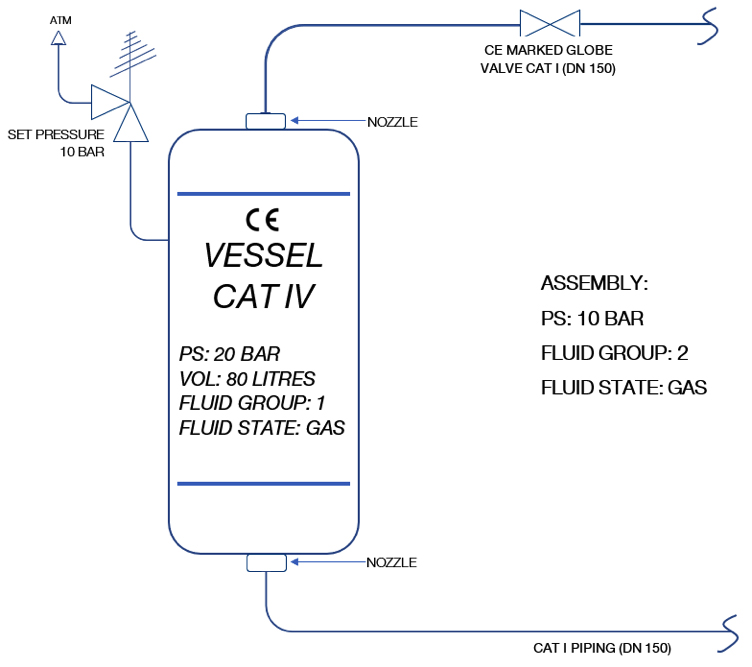
A global conformity assessment procedure can be broken down into three steps. Let’s take one at a time:
The first thing that our assembly manufacturer must do is assess each category I to IV item of pressure equipment making up the assembly which has not been previously subjected to a conformity assessment and been UKCA marked. The assessment procedure is determined by the category of each item of pressure equipment6.
Immediately you can see that the purchased items don’t need to be considered, because they have already been UKCA marked, and so the respective manufacturers should have already undertaken the conformity assessment procedure. The only remaining item is the category I piping, and any of the conformity assessment modules7 could be applied to it by our assembly manufacturer, although Module A would be suitable and doesn’t require a Approved Body8.
The second thing that our assembly manufacturer must do is assess the integration of the various components of the assembly9. Now, those of you have read the Directive with a keen eye may have noticed that it only refers to three essential safety requirements in this regard10, but don’t be misled by this. Any of the Directive’s essential safety requirements must be satisfied if a corresponding hazard exists11.
But in assessing the integration of the components, which conformity assessment module should our assembly manufacturer use? Well, the choice of module is determined by the PER category. And for an assembly this will be the highest category of any of the items in our assembly, based on the conditions which can occur in the assembly12. In our assembly this item is the vessel. (By the way, we disregard the category of the relief valve, which has the highest category by default, because it’s a safety accessory.)
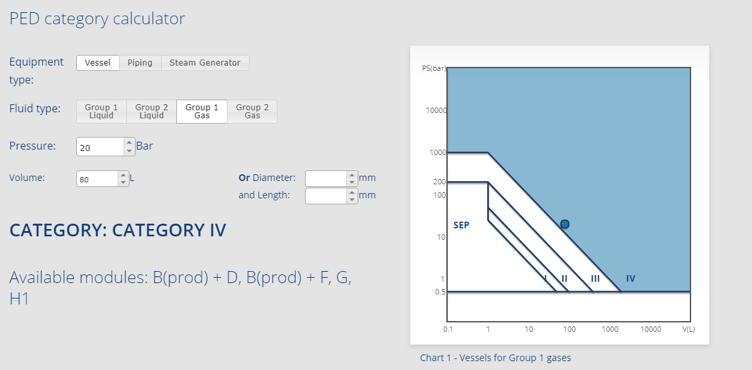
The vessel’s dataplate says that its design pressure is 20 bar, has a capacity of 80 litres and can be used for group 1 gases, and so it falls into category IV, as can be seen from HPi-CEproof’s online calculator:
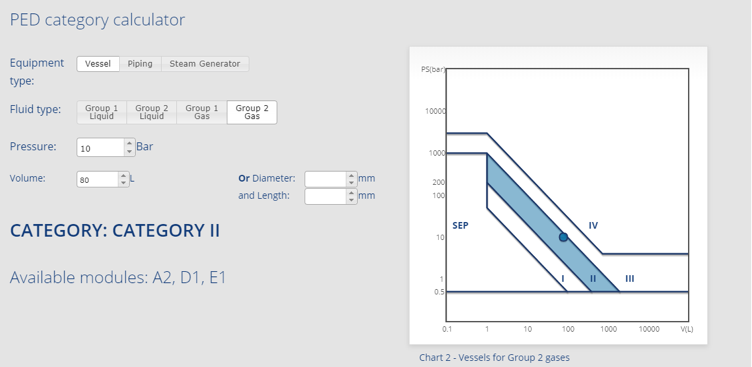
So, our assembly must be category IV, right? Well, no, not in our case. You see, the vessel manufacturer could not foresee all the applications that its vessel might be put to, and consequently it’s overengineered for the conditions which can occur in our assembly, i.e. a group 2 gas at up to 10 bar. When we apply those conditions to the vessel, it gives us category II, and consequently this is the category of our assembly. So, the assembly manufacturer could choose to apply Module A2, for example.
Before we move on to step three, now that we have ascertained that the vessel and assembly are category II, what category do you think the weld joining the vessel to the category I pipe is? Is it determined by the category of the vessel or the piping, as these are the items being joined, or perhaps by the category of the assembly? And more importantly, does it matter?
The category of the permanent joint13 between the items of pressure equipment of an assembly is determined individually (so in other words, not by the category of the assembly), considering the effect of the joining on the integrity of each of the items to be joined14.
If you look at the drawing, you will see that the vessel has nozzles, and these will have the same nominal diameter as the category I pipe. The connection of a pipe to a vessel through a nozzle is made according to the category of the pipe (provided that it does not affect the integrity of the vessel)15. Hence, in our case it’s a category I joint. Had there been no nozzle it would have been a category II joint, because that is the category of the vessel.
But why all the fuss? What does it matter? Well, it really does, because the category of the joint affects which obligations in the Directive our assembly manufacturer is required to meet. For a category I joint, the weld procedure simply needs to be ‘suitable’ and the welder need to be ‘suitably qualified’. For category II joints and above, however, the welding procedure and welder need to be approved by a Approved Body or Recognised Third Party Organisation16. In a similar vein, personnel undertaking NDT on category III or IV joints need be approved by a Recognised Third Party Organisation17.
The third thing that our assembly manufacturer must do is assess the protection of the assembly against its permissible operating limits being exceeded under reasonably foreseeable conditions18. In other words, the assembly should be fitted with suitable protective devices19 to prevent the minimum or maximum allowable pressure, temperature, or fluid level etc20 from being exceeded.
What are protective devices though? Well, they could be safety accessories such as relief valves, bursting discs and devices which activate the means for correction or shutdown21. Or it could be a combination of safety accessories and monitoring devices such as indicators and/or alarms which enable adequate action to be taken either automatically or manually to keep the assembly within its allowable limits22. However, monitoring devices alone won’t suffice23.
And last but not least, those safety devices should be checked at the final inspection to ensure that they have been installed24.
Conformity assessment procedures are critical not only to demonstrating that an item of pressure equipment or assembly is in compliance with the Directive, but also ensuring that it is safe. Failing to do so could result in an injury or be fatal, and we’re not speaking figuratively this time.
A cornerstone of demonstrating compliance with the Directive is a hazard analysis and risk assessment, so we’ll look at that in the next issue.
In the meantime, I’ll try to work out what goes well with these mauve needlecord trousers.